IP20 vs. IP67 LED Drivers: When to Use Indoor Rainproof Enclosures
Selecting the appropriate Ingress Protection (IP) rating for an LED power supply is a foundational step in ensuring the safety, thermal performance, and operational lifespan of commercial lighting installations. Lighting specifiers, electrical installers, and B2B buyers frequently debate whether to deploy lightweight IP20 indoor drivers or sealed, heavy-duty IP67 weatherproof drivers.
Using a fully potted waterproof unit in a dry interior environment can lead to inefficient thermal performance and unnecessary expense, while installing an unsealed unit in humid or dust-heavy locations creates severe electrical shorting risks. This guide breaks down environmental protection standards, heat dissipation mechanics, structural tradeoffs, and strategic application scenarios for both driver types.
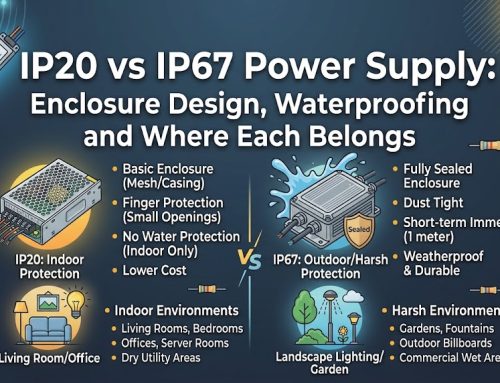
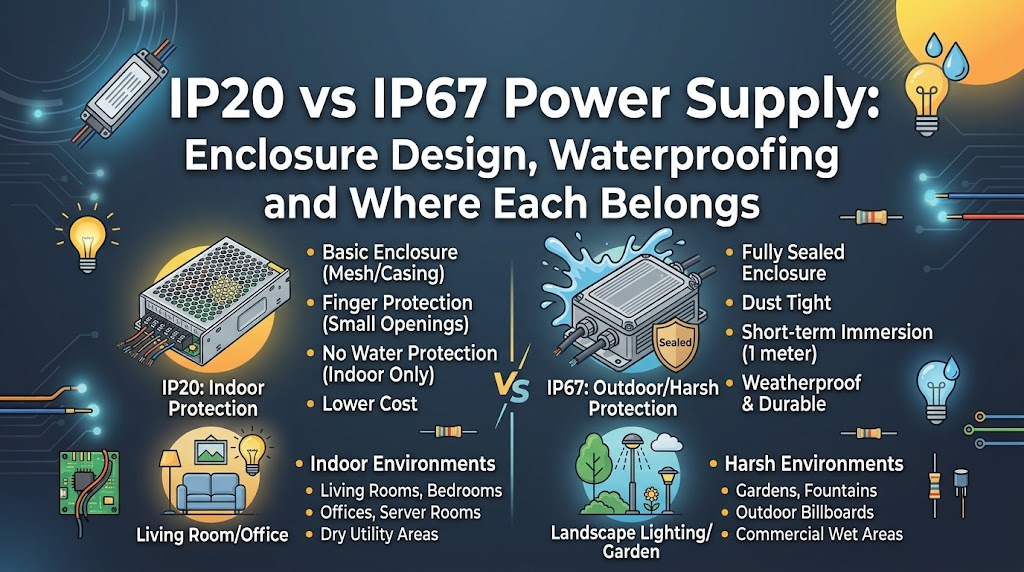
Demystifying IP Protection Standards (IP20 vs. IP67)
The International Protection marking (IEC standard 60529) classifies the degree of protection provided by mechanical enclosures and electrical enclosures against intrusion, dust, accidental contact, and water.
+---------------------------------------------------------------------------------------------------+
|                                     IP Rating Structural Breakdown                                 |
+-------------------+-----------------------------------+-------------------------------------------+
| Feature           | IP20 (Indoor Open Aluminum)       | IP67 (Outdoor Sealed / Potted)            |
+-------------------+-----------------------------------+-------------------------------------------+
| Solid Protection  | Level 2: Objects > 12.5mm (Fingers)| Level 6: Dust-tight (Total dust barrier)  |
| Liquid Protection | Level 0: Non-protected against water| Level 7: Immersion up to 1m depth        |
| Housing Style     | Perforated / Ventilated Metal Shell| Fully Sealed Aluminum / Polycarbonate Case|
| Internal Filling  | Air Convection (Unpotted)         | Thermal Epoxy Resin (Fully Potted)        |
+-------------------+-----------------------------------+-------------------------------------------+
IP20 Rating Mechanics
An IP20 rating signifies protection against solid objects larger than 12.5 mm (preventing accidental finger contact with terminal blocks), but provides zero protection against liquid ingress.
-
Design Purpose: Optimized exclusively for indoor, climate-controlled, dry environment installations.
-
Structural Profile: Features perforated aluminum casings designed to promote passive air convection directly around internal switching transformers and power transistors.
IP67 Rating Mechanics
An IP67 rating ensures total protection against airborne dust particles and guarantees resistance against temporary water immersion (up to 1 meter depth for 30 minutes).
-
Design Purpose: Engineered for harsh exterior environments, industrial washdown zones, and heavy moisture exposure.
-
Structural Profile: Fully enclosed housing filled with thermal silicone or epoxy potting compound that completely seals all circuit board components from external elements.
Thermal Management and Dissipation Efficiency
Heat is the primary cause of component degradation in solid-state lighting systems. The method used to achieve ingress protection directly alters how a driver manages operating temperatures.
IP20 Convection Airflow:  [ Ambient Air ] ──► ( Perforated Housing ) ──► [ Direct Component Cooling ]
IP67 Epoxy Conduction:   [ Junction Heat ] ──► ( Epoxy Compound ) ──► [ Metal Outer Shell ] ──► [ Ambient Air ]
Thermal Mechanics of IP20 Drivers
IP20 units utilize open-frame or mesh aluminum enclosures. Because internal electrical components are exposed to ambient room air, heat dissipates rapidly through natural air circulation.
-
Airflow Optimization: Eliminating thick potting compounds keeps the total physical weight light and allows rapid cooling during continuous peak load operation.
-
Component Lifespan: Lower ambient running temperatures inside dry dropped ceilings extend the operating life of internal electrolytic capacitors.
Thermal Mechanics of IP67 Drivers
In IP67 drivers, internal heat must travel through thick epoxy potting compound before reaching the outer metal shell to radiate away.
-
Thermal Lag: While thermal epoxy acts as a heat conductor, it retains heat longer during sustained operation than open-air convection systems.
-
Enclosure Size: To account for thermal expansion and surface area requirements, IP67 drivers are typically bulkier and heavier than equivalent-wattage IP20 units.
Structural Form Factors and Profile Constraints
Commercial space design increasingly requires light fixtures to be integrated directly into architecture, placing strict limits on driver dimensions.
+---------------------------------------------------------------------------------------------------+
|                                 Mechanical Profile Comparison                                     |
+-------------------+-----------------------------------+-------------------------------------------+
| Dimension Metric  | Ultra-Slim IP20 Units             | Standard Sealed IP67 Units                |
+-------------------+-----------------------------------+-------------------------------------------+
| Height Profile    | Ultra-low profile (18mm - 30mm)   | Thicker cross-section (35mm - 50mm)       |
| Width             | Slim linear width (30mm - 45mm)   | Wider footprint (60mm - 90mm)             |
| Total Weight      | Lightweight (Easy wire tension)   | Heavy (Requires solid mounting anchors)   |
| Mounting Flexibility| Fits narrow linear extrusions    | Requires spacious junction boxes          |
+-------------------+-----------------------------------+-------------------------------------------+
When integrating power supplies inside narrow dropped ceiling slots, cabinet frames, or linear aluminum profiles, choosing an ultra-slim IP20 design—such as the 250w indoor led driver 24v 10.4a ip20 specification—ensures seamless mounting without requiring custom architectural cutouts.
Cost Efficiency and B2B Budget Optimization
Specifying electrical equipment requires balancing reliability with overall system cost.
-
Material Costs: IP67 drivers require specialized waterproof gland connectors, silicone seals, high-grade potting resins, and heavy-gauge rubberized cables. This increases manufacturing costs by 25% to 40% compared to IP20 units of equal wattage output.
-
Installation Efficiency: IP20 units utilize user-friendly screw terminal blocks, allowing electricians to wire input and output leads directly without needing waterproof cable splices or heat-shrink tubing.
For large-scale commercial office buildings, retail malls, or interior hotel lighting projects, selecting IP20 drivers for dry zones maximizes project budget efficiency without compromising electrical integrity.
Application Matrix: Selecting the Right Driver Rating
Matching the IP rating to the exact environmental conditions prevents premature failures and avoids unnecessary budget expenditure.
[Installation Site Analysis]
       │
       ├──► Dry Interior Space? (Office, Retail Cove, Bedroom Cabinet)
       │      └──► Choose: IP20 Slim Convection Driver
       │
       ├──► Humid Indoor Area? (Commercial Kitchen, Bathroom Ceiling, Cold Storage)
       │      └──► Choose: IP65 / IP67 Rainproof Sealed Driver
       │
       └──► Outdoor Environment? (Building Facade, Landscape Lighting, Signage)
              └──► Choose: IP67 Fully Potted Waterproof Driver
Recommended IP20 Applications
-
Commercial Office Linear Lighting: Recessed ceiling slots, pendant profiles, and continuous tray lighting using an indoor led driver ip20.
-
Retail Display & Cabinetry: Under-shelf strip lighting, display cases, and indoor accent coves.
-
Indoor Signage & Lightboxes: Thin channel letter backlighting and fabric lightboxes mounted in dry indoor spaces powered by a high-efficiency 250w indoor power supply.
Recommended IP67 Applications
-
Exterior Building Facades: Outdoor wall washing, contour linear lighting, and roofline accents.
-
Landscape Illumination: Underground well lights, garden bollards, and fountain perimeter lighting.
-
High-Humidity Interior Zones: Indoor swimming pool enclosures, commercial dishwashing stations, and cold-storage facilities prone to heavy condensation.
6. Electrical Safety, Wiring, and Installation Best Practices
Proper installation protocols ensure long-term stability and code compliance regardless of driver enclosure type.
Installation Guidelines for IP20 Indoor Drivers
-
Maintain Airflow Clearance: Always maintain a minimum clearance of 5 cm around ventilated openings to allow uninhibited convection cooling.
-
Dust Protection During Construction: Complete all dry-wall sanding, painting, and ceiling work before installing open-mesh IP20 drivers to prevent fine dust from coating internal circuit boards.
-
Secure Terminal Connections: Ensure input and output copper wire ends are fully inserted into terminal cages and tightened securely to prevent loose-arc heating.
7. Quality Standards and Technical Specification Checklist
When procuring B2B power supplies for commercial specifications, ensure the products meet international safety and performance benchmarks.
B2B Engineering Specification Checklist
-
Electrical Safety Certifications: Verify compliance with CE, RoHS, and UL standards for commercial power equipment.
-
Protective Features: Ensure integrated Short Circuit Protection (SCP), Over Load Protection (OLP), and Over Temperature Protection (OTP) with auto-recovery functionality.
-
Power Factor Compliance: Select drivers maintaining a High Power Factor () to meet commercial building energy standards and reduce total harmonic distortion.
Summary & Procurement Checklist
Understanding the clear distinction between IP20 convection-cooled drivers and IP67 potted waterproof units prevents over-specifying hardware while ensuring long-term project reliability.
Specifier’s Final Action List
-
Evaluate Environmental Moisture: Confirm whether the installation site is dry indoor or subject to moisture/dust exposure.
-
Measure Physical Cutout Profile: Verify depth and width constraints inside light channels or ceiling cavities.
-
Calculate Total Wattage Load: Apply the 80% load rule to total LED strip power consumption.
-
Verify Thermal Clearance: Ensure sufficient ambient airflow space around IP20 perforated housings.
To verify technical parameters, electrical load specifications, and dimensions for your current project, refer directly to the official 250w indoor led driver 24v 10.4a ip20 product page.