Power Supply Efficiency Ratings Explained: 80 PLUS, DoE Level VI, ERP and What Buyers Need
“Power supply efficiency” shows up on every datasheet as a single percentage. That number is the most quoted and least useful figure in the industry. The headline 90% at 50% load tells you almost nothing about what your unit does at 40% load in a hot closet—which is where it actually runs.
What 80 PLUS actually measures
80 PLUS certifies that a supply hits 80% or better at 20%, 50% and 100% of rated load, at 115V input. The tiers—Bronze (82% at 50%), Silver, Gold (87%), Platinum (90%), Titanium (94% at 50%, 90% at 10%)—are all measured the same way. The 80plus.org registry lists the real tested models; if a vendor’s part is not there, the claim is unverified.
Counterintuitive point one: the 50% load point is a lab convenience, not your deployment. Most fixed installations cruise at 40–60% load, but a supply tuned to peak at 50% can dip 3–5 points outside that window. For a 200W unit running at 90W (45%), you may be at 87% not 90%. Always read the full load curve, not the badge.
DoE Level VI and ERP: the legal floor, not a bonus
External power supplies shipped to the US must meet DoE Level VI; to the EU, ERP Lot 9 (2019). These set minimum average efficiency AND a no-load standby limit—DoE VI requires under 0.1W draw when the load is off. A “more efficient” design that ignores standby can be illegal to import even if its active efficiency is higher. For “led driver certification,” check both the active tier and the vampire draw.
Counterintuitive point two: a higher-efficiency design can be disqualified by its own standby. We saw a 150W driver hit 91% active but draw 0.15W idle—failing DoE VI by 50%. The fix was a better off-line switcher, not a bigger transformer. Efficiency and standby are separate specs; certify both.
Why efficiency sometimes does not pay back
Platinum costs roughly 4–7 more per 200W unit than Gold. At 10 h/day and $0.13/kWh, the saved electricity is about $1.10–$1.80/year. Over a 3-year install you lose money on the upgrade. Gold is the economic optimum for most 8–10h duty cycles; Titanium only wins for 24/7 duty (data centers, telecom) or where cooling cost dominates. Spec the tier to the runtime, not the brochure.
Efficiency buys size, not just watts
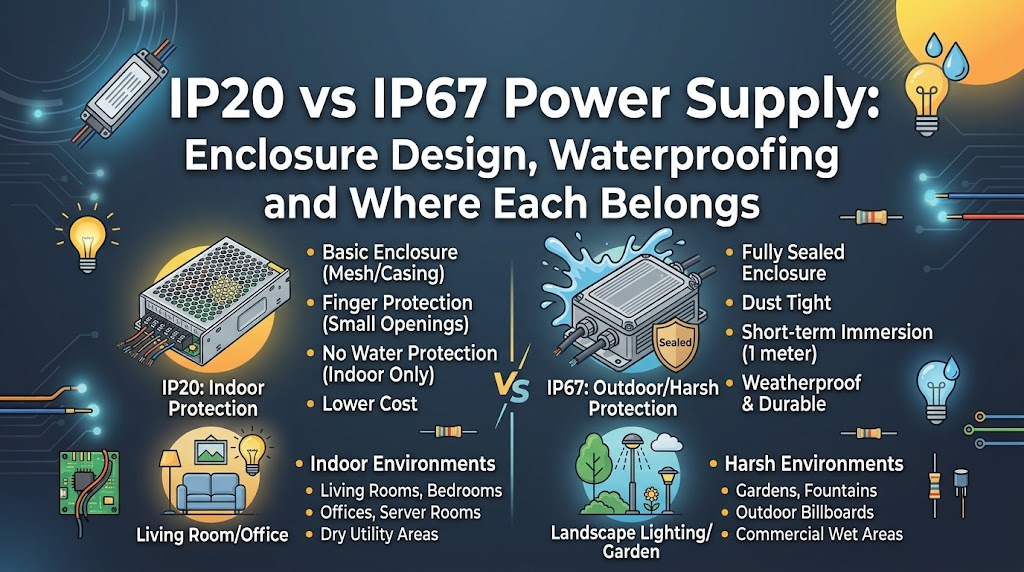
Counterintuitive point three: the underrated win from higher efficiency is thermal headroom. A 90% unit dumps 10% of input as heat; an 85% unit dumps 15%. In a sealed IP67 case that 5% is the difference between a fan and passive cooling, or between a 60 °C and a 75 °C internal temp. For “medical power supply requirements,” where 60601-1 caps leakage and trusts reliability, the cooler supply is the safer supply even at equal watts.
Certification map for B2B buyers
- IT/AV, North America: UL 62368-1; efficiency DoE Level VI.
- EU: CE LVD + EMC; ERP Lot 9; ENEC for luminaires.
- Medical: IEC 60601-1, 2× MOPP, leakage <100 µA—efficiency is secondary to isolation.
- Industrial: IEC 61558 or 62368-1 by application.
How to read a spec sheet
- Ask for the full efficiency curve at 115V and 230V, 20/50/100%.
- Confirm no-load standby <0.1W (DoE VI) / <0.15W (ERP).
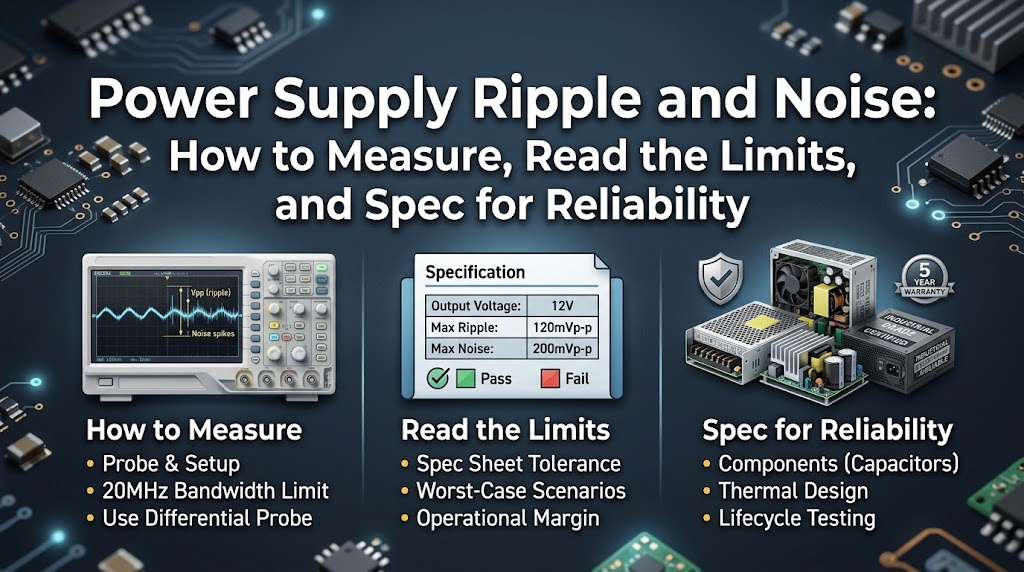
- Check the 60 °C efficiency, not 25 °C—most field failures trace to hot-efficiency droop.
- Match the tier to duty hours, not to the sales pitch.
Closing
Efficiency is real, but the badge is a summary, not the data. The buyer who reads the 230V/50% curve and the standby line out-ranks the one who quotes “90% efficient” from memory. Search for “power supply efficiency” rewards the explainer that separates law from marketing.