LED Driver Selection: Constant Current vs Constant Voltage, Dimming and IP
The fastest way to kill an LED installation is to buy the driver by wattage alone. A “250W indoor LED driver 24V 10.4A” and a “60W indoor LED driver 24V 2.5A” are not the same product with less power—they live in different thermal and regulatory worlds. This guide is for the engineer who specs the driver, not the buyer who compares prices.
Constant current vs constant voltage: the naming lie
Here is the part nobody tells juniors: LEDs are current devices. They want a fixed current, and their forward voltage drifts with temperature. A “constant voltage” LED driver is therefore a misnomer for bare LEDs—it only works because the LED module has its own current-limiting resistor or a built-in CC stage. Use a 24V CV driver on a bare COB and you get thermal runaway; the module heats, its Vf drops, current climbs, it heats more.
- Constant voltage (12V/24V): for LED strips and modules that already regulate current. Dominant in signage and cove lighting.
- Constant current (350mA/700mA/1050mA): for COB and high-power packages. This is what “oem constant current led driver manufacture” buyers actually need.
- Constant power: holds watts across a voltage window—useful when Vf shifts with temp, common in horticulture and outdoor.
Counterintuitive point one: for a bare COB, a CV driver is the wrong tool dressed as the easy one. Specifiers reach for 24V because the wiring looks like low-voltage lighting, then wonder why modules fail at month 8. If the load is a COB, specify CC.
Dimming: current, not brightness
“Dimming protocols” sounds like a menu of remotes. In reality you are choosing how to cut current. 0-10V (often labeled LEDdim) reduces the driver’s output current from 100% at 10V to ~10% at 1V. Below 10% it gets ugly: color shift, flicker, or the driver dropping to off. PWM dimming chops the current digitally and holds color far better, but needs a compatible driver and clean grounding.
Counterintuitive point two: DALI (IEC 62386) is not “better dimming,” it is addressable control. A DALI driver costs 3–6 more than 0-10V and buys you per-fixture addressing and status feedback—worth it for a 500-fixture building, wasted on a single light box. Spec the protocol to the building, not the bulb.
Why 250W is not a bigger 60W
A 250W 24V unit pushing 10.4A sustained sits at the edge of its thermal envelope inside a sealed fixture; a 300W unit derated to 250W runs cooler and lasts longer. The nameplate wattage is a ceiling, not a cruising point. Real installs run drivers at 60–80% load, and a unit specified at exactly 100% will hit OTP (over-temperature protection) on a warm afternoon and strobe.
For the “250w indoor led driver 24v 10.4a ip20,” pair it with an IP20 enclosure only in a climate-controlled space. Put it in a warehouse ceiling and you have traded water protection you did not need for heat protection you did. A vented IP20 with passive convection beats a sealed can at the same wattage.
IP rating and where the driver lives
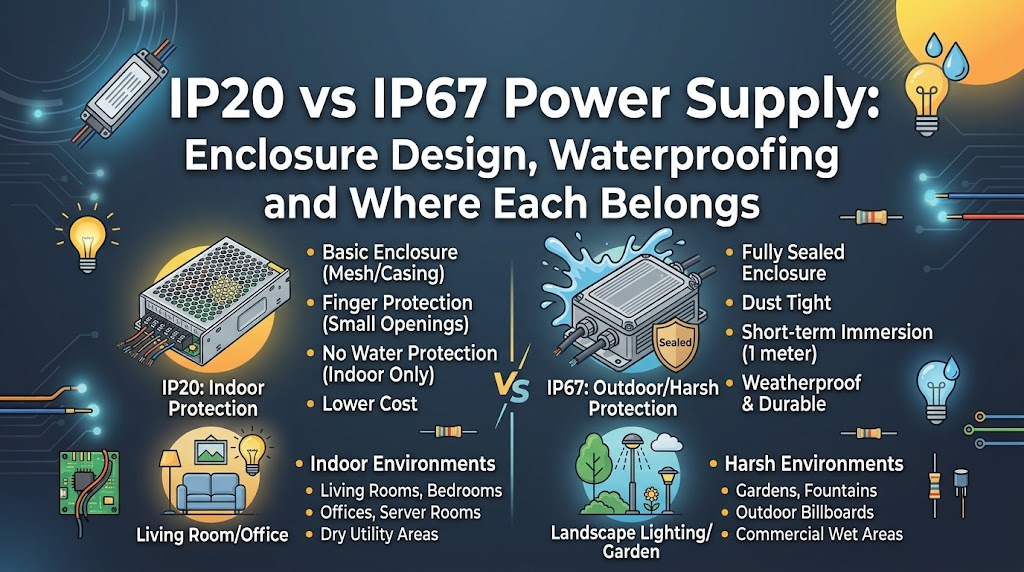
Indoor (IP20) drivers belong in dry, ventilated spaces—offices, retail ceilings. Outdoor and damp locations need IP65/IP67; the “waterproof plastic case switching power supply” family uses a potted, gasketed case. But note the failure mode: UV and thermal cycling crack the gasket in 2–3 years even when the IP67 number still holds. If the fixture faces direct sun, plan gasket replacement, not just the initial rating.
Sourcing and certification
For B2B, certs decide the shelf life of your spec. ENEC for EU luminaires, UL listed for North America, CE for the low-voltage directive. A Mean Well HLG or Osram OTi reference design shortens your cert path because the topology is already filed. Copying a reference schematic saves 6–10 weeks versus a ground-up layout—most “oem constant current led driver manufacture” quotes are reference derivatives with a different label.
Spec sheet template
- Load type: strip (CV) or COB (CC) or constant-power.
- Current/voltage window and tolerance.
- Dimming: none / 0-10V / PWM / DALI—and the minimum dim level you must hold.
- IP and ambient temp range.
- Certs by country.
- Expected life at your real load and temp (ask for the 60 °C number, not 25 °C).
Closing
The driver is 8–15% of a luminaire’s bill but causes 60%+ of field failures. Spec it like the load it is, not the box it ships in. Search intent for “led driver selection” rewards the page that explains CC vs CV with a wiring reason, not the one that lists part numbers.