Key Engineering Steps in Custom Industrial Power Supply Design for OEM Projects
Developing non-standard power supply units for specialized Original Equipment Manufacturer (OEM) machinery requires a disciplined engineering process. Unlike off-the-shelf power supplies meant for general-purpose IT or commercial installations, heavy-duty industrial systems—such as automated laser cutters, CNC controllers, semiconductor handling tools, and medical imaging units—demand tailored electrical, mechanical, and compliance specifications.
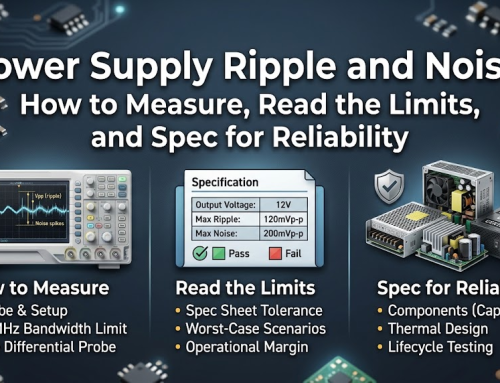
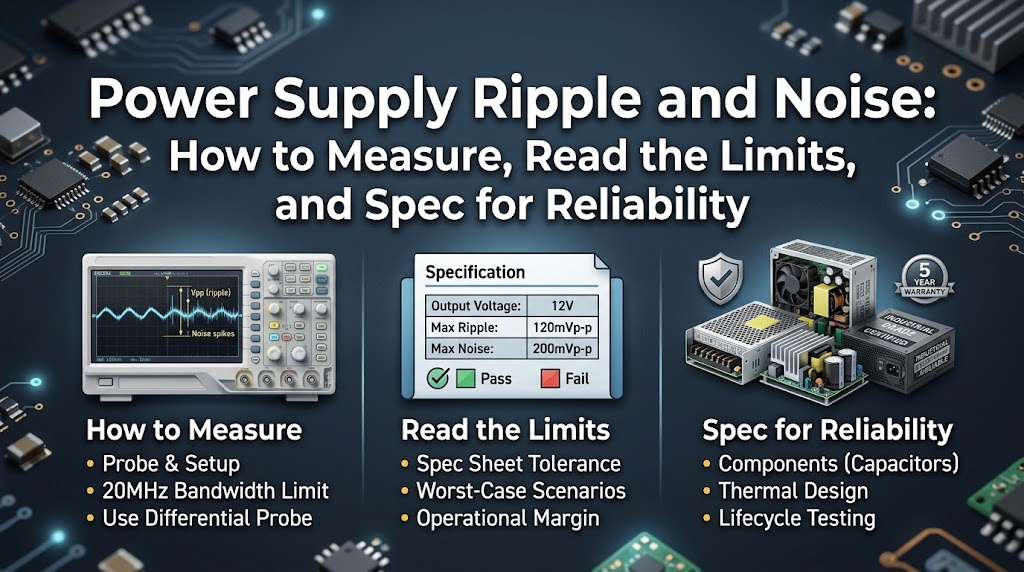
The engineering cycle begins with a comprehensive load profile analysis. Industrial loads rarely present static resistive behavior. Inductive motor drives, high-peak impulse loads, and dynamic multi-channel switching components require power supplies capable of handling high peak-to-continuous current ratios without triggering latching over-current protection (OCP). System designers must define precise regulation tolerances across multi-rail outputs, ripple/noise thresholds ($<100\text{mV}_{p-p}$), and required hold-up times during AC mains dips.
Phase two focuses on thermal circuit architecture and Component Derating Rules (CDR). Engineers select high-grade $105^\circ\text{C}$-rated electrolytic capacitors, wide-bandgap semiconductors (such as GaN or SiC FETs for high-frequency switching), and custom magnetic cores wound with Litz wire to minimize skin-effect losses. Thermal simulations ensure that component junction temperatures remain safely below manufacturer thresholds under worst-case ambient conditions.
Phase three involves electromagnetic interference (EMI) mitigation and safety isolation design. Differential and common-mode input filters must be tailored to pass EN 55032 / CISPR 32 Class B requirements, while internal creepage and clearance distances must comply with IEC/EN 62368-1 or UL 61010 standards for industrial control equipment.
Executing a rigorous custom industrial power supply design allows OEMs to integrate bespoke protection features—such as over-temperature auto-recovery, programmable constant-current limiting, and digital telemetry interfaces (PMBus, CANbus, or Modbus)—directly into their platform, ensuring operational uptime and seamless integration.