How to Choose the Right Slim LED Power Supply for Indoor Lighting
Selecting the right power supply unit (PSU) is critical for commercial lighting contractors, LED display manufacturers, and spatial designers. Modern architectural trends emphasize clean, minimal aesthetics, which often demand low-profile, ultra-slim LED drivers that can easily fit into narrow light troughs, linear aluminum extrusions, and cabinet display systems without compromising thermal stability or electrical performance.
This comprehensive B2B selection guide breaks down the essential technical parameters, thermal considerations, and IP rating choices necessary to specify the ideal slim power supply for your indoor lighting projects.
1. Introduction to Slim LED Power Supplies in Modern Lighting Design
In modern architectural lighting, structural aesthetics require component invisibility. Traditional, bulky transformers present visual clutter and limit design integration. Ultra-slim LED power supplies resolve this issue through compact linear form factors, allowing direct concealment within recessed aluminum channels, suspended linear fixtures, and custom cabinetry.
Key Advantages in Spatial Design
-
Minimalist Aesthetics: Hides completely inside shallow drop-ceilings or furniture slots.
-
Flexibility in Installation: Fits narrow enclosures where standard box-type drivers cannot fit.
-
Optimized Thermal Dissipation: Uses long, low-profile aluminum casings that maximize heat radiation along a larger surface area.
For narrow lighting structures, incorporating an ultra-slim enclosure like the Sanpu PS250-H1V ensures seamless concealment without sacrificing wattage capability.
Technical Specifications: Voltage, Current, and Load Calculations
Choosing the correct power supply requires matching the output parameters precisely with your LED strip or fixture requirements. Standard architectural indoor LED applications typically utilize constant voltage systems operating at 12V DC or 24V DC.
12V DC vs. 24V DC Systems
-
12V DC: Best suited for short-run lighting installations, low-power cabinet accents, and standard residential runs under 5 meters.
-
24V DC: Recommended for commercial projects and longer runs. Operating at double the voltage cuts current (amperage) in half, significantly reducing voltage drop over distance and allowing uniform brightness across extended continuous lines.
Calculating Required Amperage and Wattage
To ensure circuit longevity, always follow the 80% Load Rule. A power supply should continuously run at no more than 80% of its rated capacity to prevent thermal degradation and overload trips.
-
Example Calculation:
-
Total LED strip length: 10 meters
-
Strip power consumption: 18W per meter
-
Total load: $10\text{ m} \times 18\text{ W/m} = 180\text{ W}$
-
Minimum recommended driver capacity: $180\text{ W} \times 1.25 = 225\text{ W}$
-
For this scenario, selecting a 250W 24V 10.4A IP20 continuous output driver provides the required headroom and ensures stable 10.4 Amp current delivery without driving the internal components to their absolute thermal limits.
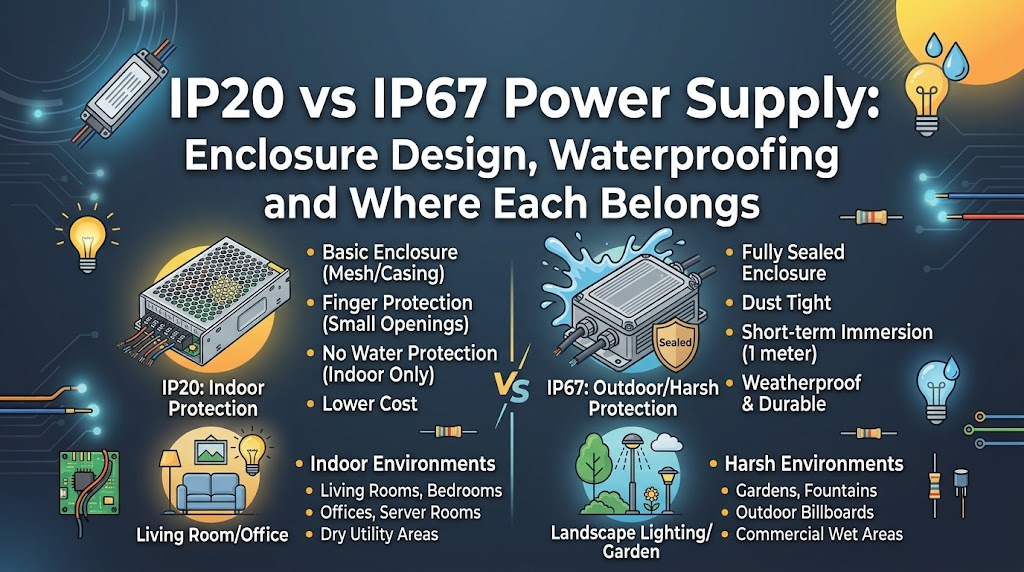
IP Rating Guide for Indoor Applications (Focus on IP20)
Ingress Protection (IP) ratings designate the level of environmental sealing against solid particles and liquids.
+---------------------------------------------------------------+
|                      IP Rating Matrix                         |
+------------------+-----------------------+--------------------+
| Rating           | Solid Protection      | Liquid Protection  |
+------------------+-----------------------+--------------------+
| IP20 (Indoor)    | Dust / Touch (≥12.5mm)| None (Unsealed)    |
| IP67 (Outdoor)   | Dust-Tight            | Water Immersion    |
+------------------+-----------------------+--------------------+
Why Choose IP20 for Indoor Projects?
-
Superior Heat Dissipation: Unsealed metal or perforated casings allow direct airflow around internal transformers and MOSFETs, cooling components faster than fully potted (epoxy-filled) IP67 outdoor units.
-
Cost Efficiency: Eliminates unnecessary waterproofing materials, reducing overall unit cost for dry interior spaces.
-
Compact Footprint: Unpotted housings achieve much thinner profiles, making them ideal for indoor linear channels, cove lighting, display shelves, and indoor signage.
Thermal Management in Compact Power Enclosures
Heat is the primary factor affecting the lifespan of electrolytic capacitors within LED drivers. In slim, low-profile designs, thermal management becomes a critical engineering challenge due to reduced interior clearance.
Cooling Mechanisms
-
Aluminum Extrusion Housings: High thermal conductivity aluminum acts as an integrated heat sink, transferring operational heat away from delicate SMT components.
-
Convection Airflow Ventilation: Open perforation patterns in IP20 slim metal cases enable natural air circulation.
-
Over-Temperature Protection (OTP): High-quality B2B drivers feature built-in OTP circuits that automatically throttle output or shut down safely if internal temperature thresholds are exceeded.
When installing slim drivers inside enclosed spaces (like wooden cabinets or shallow ceiling cavities), ensure a minimum clearance of 5 cm around the ventilation openings to maintain ambient airflow.
Installation and Safety Standards for Commercial Projects
Proper installation ensures electrical safety, electromagnetic compatibility (EMC), and compliance with local building codes.
Recommended Installation Practices
-
Short DC Cable Runs: Keep secondary (DC output) cable lengths as short as possible to prevent resistance-induced voltage drops and flickering.
-
Primary Grounding: Always connect the Earth Ground wire to the chassis terminal to avoid potential static build-up and human contact hazards.
-
Polarity Verification: Double-check $V+$ and $V-$ terminal connections prior to powering on; reversed polarity can damage sensitive LED IC drivers.
Troubleshooting Common Slim LED Driver Issues
+---------------------------------------------------------------------------------------------------------+
|                                    Troubleshooting Diagnostic Matrix                                   |
+------------------------------------+--------------------------------+-----------------------------------+
| Symptom                            | Probable Cause                 | Recommended Action                |
+------------------------------------+--------------------------------+-----------------------------------+
| LEDs Flashing / Strobing           | Overload Protection Tripped    | Recalculate load; verify 80% rule.|
| Output Voltage Drop at Strip End   | Gauge too thin / Long DC run   | Upgrade wire gauge or use 24V DC. |
| Driver Audible Buzzing             | High Frequency PWM Dimming     | Match compatible dimming module.  |
| No Power Output                    | Short Circuit / Fuse Blown     | Check wiring for reversed legs.   |
+------------------------------------+--------------------------------+-----------------------------------+
Comparing Industrial-Grade Slim Drivers with Standard Models
Standard consumer-grade transformers often compromise component density to cut costs, resulting in wider footprints, high failure rates under continuous load, and noticeable audio noise.
Industrial B2B Standard Checklist
-
High Efficiency (≥88%): Minimizes wasted heat energy.
-
Active Power Factor Correction (PFC): Maintains a high power factor ($\text{PF} > 0.95$), reducing harmonic distortion on commercial power grids.
-
Precision Voltage Output: Maintains output voltage stability within $\pm 0.5\text{V}$, preventing color shifts or premature LED phosphor degradation.
High-output slim drivers, such as industrial 250W 24V 10.4A LED drivers, offer built-in short circuit, overload, and over-voltage protection tailored for heavy-duty commercial deployment.
8. Summary & B2B Inquiry Checklist
Choosing the correct slim LED driver requires balancing mechanical dimensions, thermal limits, electrical capacity, and IP protection.
Specifier’s Checklist for B2B Procurement
-
Calculate Total Load: Ensure the total load does not exceed 80% of rated continuous power.
-
Confirm Operating Voltage: Match exact strip specifications (12V vs 24V DC).
-
Verify Physical Clearance: Check length, width, and height against enclosure dimensions.
-
Verify Ingress Protection: Use IP20 for dry indoor applications to maximize heat dissipation.
For bulk OEM inquiries, custom voltage configurations, or full spec sheets on ultra-slim power solutions, review technical documents like the Sanpu PS250-H1V Datasheet to ensure full compliance with your project specifications.