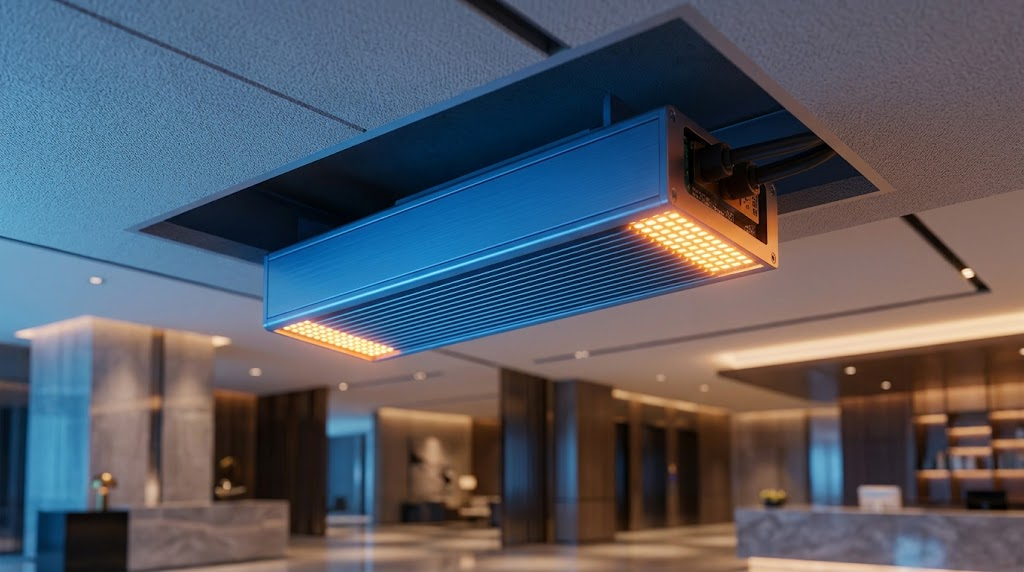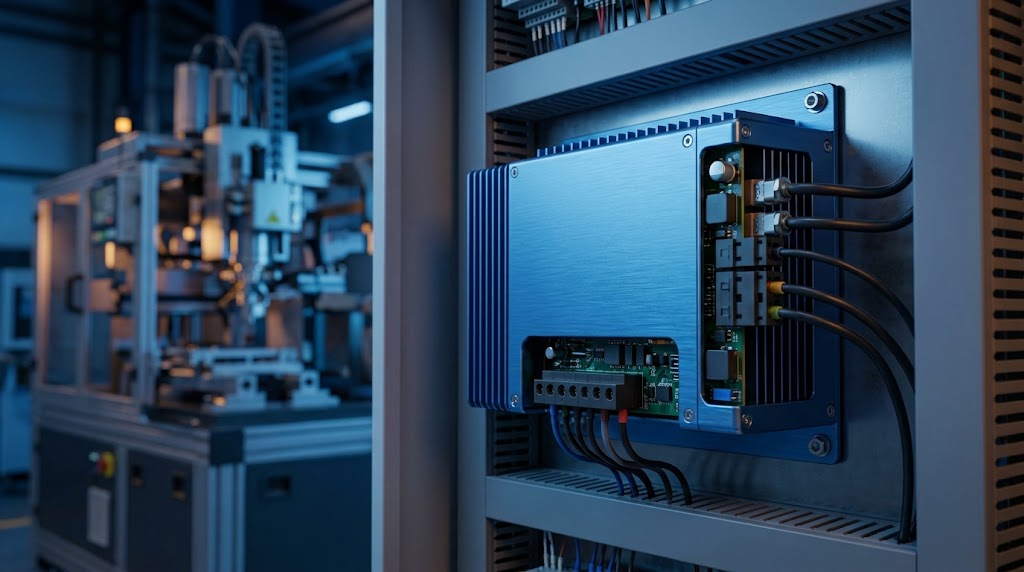
Industrial Quality Control: Inside the Sanpu Factory
To replace industry-standard brands, a power supply must prove its reliability through ruthless testing. Standard switching power supplies can fail prematurely due to component degradation under thermal stress. To prevent this, every san power unit undergoes strict quality gates before leaving the assembly line:
[Component Sourcing] ──> [SMT Assembly] ──> [100% Full Load Burn-in (4 Hours)] ──> [ATE Testing] ──> [QC Approval]
I. 100% Full Load Burn-in Testing
Every single LED driver is subjected to a rigorous 4-hour, 100% full-load burn-in test inside a high-temperature chamber. This process forces “early-life failures” to happen inside the factory, rather than at your client’s project site.
II. High-Pot & Leakage Current Validation
To guarantee human safety and international compliance, every unit undergoes high-voltage isolation (Hi-Pot) testing up to 3000V AC between input and output, ensuring complete physical safety.
III. Premium Component Selection
B2B buyers know that a power supply is only as good as its electrolytic capacitors. Premium grade, high-temperature (105°C rated) capacitors are used to ensure that even under continuous operation, the capacitance of a sanpu led power supply does not degrade prematurely.
6. How to Avoid Common Pitfalls in LED Power Installations
Even with a premium san pu driver, incorrect field installation can lead to system errors. Avoid these three common field mistakes:
Pitfall A: Severe Voltage Drop Over Long Cable Runs
Low-voltage DC (especially 12V and even 24V) suffers from resistance over distance. If you install a 250w indoor led driver 24v 10.4a ip20 15 meters away from the LED strip, the end of the strip will look dim due to voltage drop.
-
Solution: Always use the correct gauge wire (AWG) based on the current load, or place the ultra-slim power supply closer to the load by taking advantage of its slim footprint.
Pitfall B: Inadequate Ventilation in Enclosed Spaces
While many slim drivers are “fanless” (relying on convection cooling), they still need ambient air to transfer heat. Sealing a fanless driver inside a completely airtight wooden cavity without a metal backing plate will severely shorten its life.
-
Solution: Mount the driver directly against an aluminum track or metal sheet to act as a supplementary heat sink.
Pitfall C: Forgetting Inrush Current Calculations
When a switching power supply is turned on, it draws a massive, instantaneous current spike (inrush current) to charge its internal capacitors. If you have 10 units of 150W drivers connected to a single circuit breaker, the combined inrush current can instantly trip the breaker.
-
Solution: Group your power lines onto separate breakers, or utilize drivers with soft-start circuitry.
Conclusion: Take Control of Your Project Sourcing
In the commercial lighting and industrial automation space, relying on a single, expensive legacy brand is a high-risk procurement strategy. Embracing highly specialized, robust alternatives allows your business to offer competitive project bids, customize physical designs, and secure superior profit margins.
Whether your next project demands a low-profile cfx150 for custom linear lighting, a silent 250w indoor led driver 24v 10.4a ip20 for indoor lightboxes, or a heavy-duty ps600-h1v24 to drive dense automation equipment, selecting the right partner is the ultimate key to project success.
Need Expert Assistance with Your Bill of Materials (BOM)?
Send us your current project requirements or the competitor part numbers you are using today. Our dedicated application engineers will provide a free, comprehensive cross-reference and custom pricing quotation within 24 hours.
👉 Contact Sanpu Power Today to Optimize Your Lighting Project