How to Design a Custom Power Supply for Specific Applications
When Do You Need a Custom Power Supply?
While off-the-shelf catalog power supplies satisfy 80% of standard applications, specialized medical devices, defense hardware, and unique industrial machinery often require custom form factors, non-standard voltage rails, or specific enclosure dimensions. Partnering with experienced manufacturers listed on Sanpu Power ensures professional engineering guidance from concept to mass production.
Step 1: Defining Electrical and Mechanical Requirements
Establish clear specifications before drafting schematics:
-
Input voltage range (universal AC or specific DC battery inputs).
-
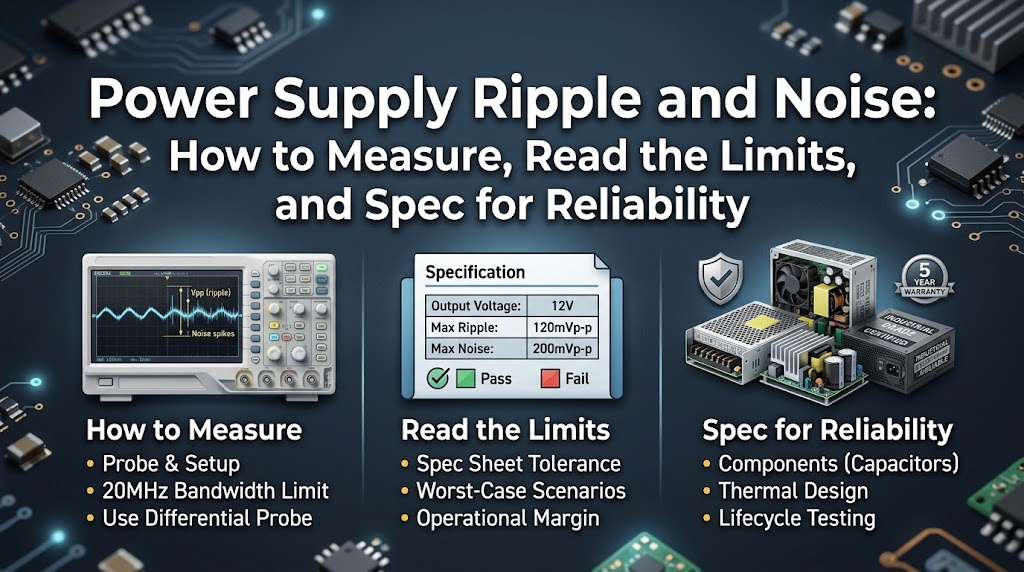
Output voltage rails, current limits, and ripple tolerance.
-
Mechanical footprint constraints and mounting style (such as custom chassis or slim power supply enclosures).
Step 2: Schematic Design and Component Selection
Engineers select switching topologies (flyback, forward, half-bridge) based on power levels and efficiency goals. Selecting high-reliability capacitors, transformers, and switching MOSFETs ensures long-term field durability.
Step 3: Prototyping and Breadboard Testing
Fabricate initial prototype boards to test electrical performance, thermal behavior under full load, and transient response during rapid load shifts.
Step 4: Safety Compliance and EMC Pre-Compliance Testing
Subject prototypes to pre-compliance testing for conducted and radiated electromagnetic emissions (EMC), surge immunity, and dielectric isolation to guarantee smooth certification clearance.
Step 5: Design for Manufacturing (DFM)
Optimize the physical layout for automated Surface Mount Technology (SMT) assembly, ensuring cost-effective mass production and consistent quality control.
Working with OEM/ODM Power Supply Manufacturers
Collaborating with seasoned ODM partners reduces time-to-market and mitigates development risks. Share your detailed requirement checklist early to align expectations on tooling costs and delivery schedules.
Timeline and Cost Considerations
Custom power supply development typically spans several months from initial specification sign-off to pilot production runs. Budgeting for prototype iterations ensures a polished final product.
Summary and Next Steps
Designing a custom power solution unlocks competitive advantages for specialized equipment manufacturers. Begin your custom engineering journey by consulting the experts at Sanpu Power Supply.