What You’re Actually Paying For: NRE, Tooling, MOQ and the 12 Weeks Inside a Custom Power Supply Quote
A customer building smart vending cabinets sent us an RFQ last month. 24 V, 150 W, IP65, −20 °C to +50 °C, 0–10 V dimming, 800 units on the first order. They had a number in three days: $18.60 per unit.
The same week, a different buyer asked “how much for a 24 V waterproof power supply?” and got “it depends on the spec” back.
The difference between those two replies isn’t negotiating skill. The first buyer sent a spec an engineer could actually price. The second sent a sentence, and the only thing an engineer can do with a sentence is price the uncertainty — which means padding the unit price until the risk feels covered.
This article takes a custom power supply quotation apart: the three piles of money sitting underneath the unit price, why MOQ lands on 500 / 1,000 / 3,000 and not on round numbers in between, where twelve weeks actually goes, and which three spec changes quietly double the cost of a project.
The unit price is only 60–70% of what you’ll pay
A custom power supply quote has four layers. Most procurement teams only see the first one.
Layer 1 — Unit price. BOM plus manufacturing overhead plus margin. On a 150 W switch-mode supply, the three most expensive things in the BOM are usually:
| Item | Share of BOM |
| High-frequency transformer (core + copper) | 12–18% |
| Electrolytic capacitors | 8–12% (a 105 °C long-life part costs 30–50% more than an 85 °C one) |
| Power MOSFETs and rectifiers | 10–15% |
| PCB, enclosure, harness, terminals | 15–20% combined |
Layer 2 — NRE (non-recurring engineering). Schematic, PCB layout, transformer design, prototype bring-up, EMC pre-testing. For a platform modification — existing topology, new output voltage, new housing, new cable length — NRE typically runs 3,000–12,000. For a new topology, it starts around $15,000 and clears $40,000 once full safety and EMC support is bundled in.
Layer 3 — Tooling and fixtures. Aluminium extrusion die 3,000–8,000. Plastic injection mould 8,000–30,000 depending on cavity count and tolerance. Potting jig, test fixture and burn-in rack 1,000–5,000 each. The enclosure is the only item in this layer that has to be re-cut every time it changes.
Layer 4 — Certification. Underrated, and the layer that blows budgets. CE/ENEC 5,000–15,000. UL/cUL 8,000–25,000. CB report plus certificate 6,000–12,000. Medical IEC 60601-1 on its own 15,000–35,000. And it isn’t one-and-done: change the output cable spec, switch capacitor vendors, or move a vent 5 mm, and you may be back in the chamber.
Run the numbers on that first RFQ. 800 × $18.60 = $14,880. Add an aluminium extrusion die (6,000), UL listing (12,000) and NRE ($8,000), and the real invoice is $40,880 — a true unit cost of $51.10, or 2.7× the number on the quote.
That’s why “what’s your unit price” never produces a useful answer.
Why MOQ is 500, 1,000 or 3,000
Those three numbers keep appearing because each one maps to a real constraint on the factory floor.
500 — the SMT changeover floor. A changeover on a mid-speed SMT line means new program, new stencil, new feeder setup: roughly 2–4 hours of stopped line. That loss has to be amortised into the order. Below about 500 units you’re not paying a material premium, you’re paying for line downtime.
1,000 — the custom magnetics threshold. Winding shops have minimums on copper and bobbins. Winding 300 custom transformers versus 1,000 can differ by 40% per piece, and most of that gap isn’t copper — it’s winding fixture setup time and wire scrap rate.
3,000 — the long-lead purchasing tier. 105 °C long-life electrolytics, specific MOSFET brands, custom harnesses: for small quantities these are either unavailable or only available at spot-market premium. At 3,000 you can usually buy direct from the manufacturer on terms, which takes 8–15% off the BOM.
Here’s the part that surprises people:
Cutting MOQ from 3,000 to 500 raises the unit price by roughly 8–15%. It raises the NRE buried in each unit by 6×.
$8,000 of NRE spread over 3,000 units is $2.67 each. Over 500 units it’s $16.00 each. Meanwhile the unit price itself goes from $18.60 to about $21 — a $2.40 move.
So on a small-batch project, arguing over five cents on the unit price is the wrong fight. The fight worth having is NRE relief. The standard trade is a 12–18 month framework volume commitment — often only a letter of intent — in exchange for 50–100% off first-order NRE. From the supplier’s side that’s low risk: the engineering cost gets recovered on year two. From your side it’s the single biggest lever on first-order cost.
Where twelve weeks actually goes
“Lead time 8–12 weeks” is true and useless. Broken into weeks, you can see which blocks are compressible and which are not.
| Weeks | Stage | Compressible? |
| 1–3 | Spec lock, concept design, key component selection | Yes. Entirely dependent on how complete your spec is |
| 3–5 | PCB layout and prototype build | ~1 week, for $300–800 in expedite fees |
| 4–9 | Long-lead procurement (transformer, custom enclosure, long-life caps) | No. Hard constraint |
| 7–11 | Safety and EMC testing | Partly — expedited slots run 1.5–2× standard fees |
| 10–12 | Pilot ramp, burn-in, volume shipment | 3–5 days, by skipping burn-in. Don’t |
Weeks 4 through 9 are the ones that matter. Inside them, the two worst offenders are the custom transformer (wind, varnish, test: 3–4 weeks) and the custom enclosure (extrusion die, trial shot, die correction: 4–6 weeks; injection moulding 6–10 weeks).
Which leads to the first counter-intuitive point:
The enclosure tooling is the one critical-path item you can lock before the electrical design is finished.
Housing dimensions depend on power level and thermal path — not on the final output voltage or control loop. On a 150 W IP65 project you can cut the extrusion die while the schematic is still moving, which pulls 4–6 weeks off the schedule by running it in parallel. Most buyers never ask, and most suppliers never volunteer it.
The second one sits in weeks 7–11:
The number one cause of compliance delay is not testing. It’s failing the first time.
First-pass rate on radiated emissions (EN 55015 / EN 55032 Class B) is somewhere around 60–70% across the industry. Fail once and you’re reworking the PCB or adding filter stages, then re-queuing at the lab — typically 3–5 weeks, longer than the original test slot.
There is exactly one cheap prevention: a pre-compliance EMC scan in week 3, using a spectrum analyser with near-field probes, for 500–1,500. It costs less than a day of engineering time and buys back five weeks.
Three spec changes that quietly double the cost
Changing the enclosure material. Swap aluminium for plastic and you’ve changed the thermal path, not the look. A 150 W unit that ran convection-cooled in aluminium usually has to be derated to about 100 W in plastic, or potted to move heat out. Potting adds $3–8 per unit in material and labour, and a potted unit cannot be reworked — every failure is scrap. Buyers file this under “material preference.” Factories file it under “new design.”
Adding UL, or going medical. CE is a self-declaration backed by a technical file. UL requires factory inspection and a follow-up service — four unannounced audits a year, 3,000–8,000 annually. Medical IEC 60601-1 demands 2×MOPP isolation: creepage and clearance roughly double, the transformer gets redesigned, and leakage current drops from a typical <0.75 mA to <0.1 mA for BF applied parts. These aren’t additive costs, they’re multiplicative.
Changing the output cable. The most innocent-looking change on the list, and the most likely to trigger retesting. Silicone cable has a higher temperature rating but different dielectric and shielding behaviour, which moves conducted emissions. Stretching a cable from 300 mm to 1,500 mm changes output impedance and voltage drop, which moves the ripple figure and sometimes forces a control-loop retune. Retest bills for this class of change run 2,000–6,000 — one to two orders of magnitude more than the cable itself.
The 12-item spec that gets you a lower first quote
A tighter spec leaves less uncertainty to price. Buyers who send all twelve of these typically get numbers 10–20% below the ones who send a paragraph, and they get them the same day instead of after three rounds.
- Input range — 90–264 VAC full range, or 200–240 VAC only? Full range costs 5–10% more in components
- Output voltage and tolerance — 24 V ±5% or ±2%? The tighter band upgrades sense resistors and the voltage reference
- Output current / power — nominal and peak. How long may it run at 110%?
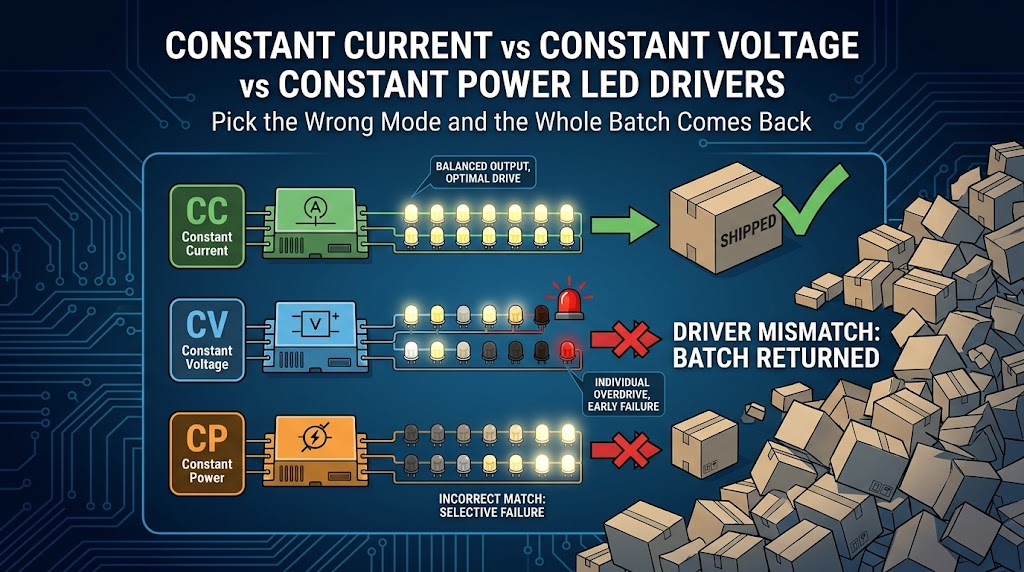
- Output mode — constant voltage, constant current, or constant power? This decides the topology
- Ripple and noise target — in mVpp under a 20 MHz bandwidth limit, e.g. ≤150 mVpp
- Efficiency target and regulation — DoE Level VI, ErP Lot 6, or CoC Tier 2
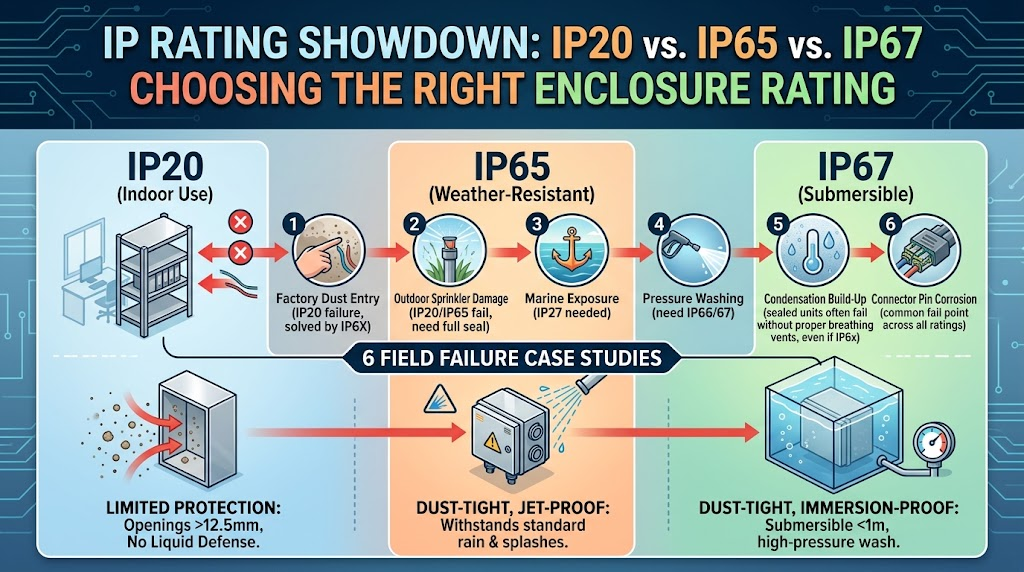
- Ingress rating — IP20 / IP40 / IP65 / IP67, and whether a breather vent is needed
- Ambient operating range — −20 °C to +50 °C and −40 °C to +70 °C are two different designs
- Mounting — DIN rail, screw-fix, or drop-in? Affects the housing structure
- Dimming / control interface — 0–10 V, 1–10 V, DALI-2, DMX512, PWM, or none
- Certification list — target markets: CE / UL / CB / ENEC / CCC / PSE / KC / BIS
- Volume and cadence — first order, rolling 12-month estimate, split shipments acceptable
Number 12 is the one most often left out and the one that moves the quote most. A buyer who says “800 now, around 5,000 over twelve months” gets materially different NRE terms than one who says “800.”
FAQ
Why is 800 units only 15% more expensive than 3,000, not four times more? Because only the BOM portion scales linearly with quantity. Manufacturing overhead — line changeover, test fixtures, burn-in racks — is fixed cost spread across the run, and BOM is typically 65–75% of unit price. What does scale non-linearly is NRE amortisation, and most suppliers list that separately rather than hiding it in the piece price.
Can NRE be waived? Often, if you have something to trade. Three common structures: a 12–18 month volume commitment, spreading NRE across three years of orders, or accepting a modification of an existing platform instead of a clean-sheet design. Clean-sheet NRE is close to non-negotiable — that’s billable engineering hours.
How much longer does a new development take versus a platform modification? Modification runs 6–9 weeks, new development 14–22. The extra 8–13 weeks sit in transformer design iterations, the full certification cycle, and a second prototype validation round.
Can I get 50 prototypes first? Yes, but prototypes don’t run on the volume line. They’re built by hand or semi-manually at 3–8× production cost, and their test data doesn’t represent production consistency. Better structure: run the first 800 as production and treat the first 50 off the line as your validation samples. Most suppliers will agree to that.
Does swapping the output capacitor brand require retesting? Depends which parameters move. Same brand-equivalent specs — capacitance, voltage rating, ESR, ripple current rating, life grade — is usually a documentation update. Change ESR or ripple current rating and you retest output ripple and capacitor temperature rise. Drop the life grade from 105 °C / 8,000 h to 105 °C / 5,000 h and the product life claim changes, with possible certification notification.
Why won’t suppliers amortise certification into the unit price? They can, but most won’t. The certificate is registered to a specific model and manufacturer, so the cost has nothing to do with order size; folding it into piece price wrecks cost accounting on the second order. The more common arrangement is a separate line item — or “free certification” with the certificate held in the supplier’s name, which is a trap for OEMs: you paid for it, you don’t own it, and switching suppliers means starting over.
Why do quotes expire in 30 days? Copper and aluminium volatility. A 150 W supply carries copper in the transformer windings and PCB plus aluminium in the housing — together maybe 20–25% of BOM. A 10% monthly move in copper eats two points of margin. Thirty days is the industry norm; past that it gets requoted.
How do I tell whether a quote is padded? Look at three things: is NRE listed separately (if not, the padding is in the piece price and you can’t negotiate it), does the certification line state who owns the certificate, and are there volume breaks (800 / 3,000 / 10,000)? All three transparent usually means under 8% padding. All three opaque means you have nothing to push against.
The honest version
On a custom power project, the most expensive line item is never the transformer. It’s the three weeks spent clarifying requirements, and the five weeks after an EMC failure. Two hours more on the spec sheet saves three weeks. $1,500 on a pre-compliance scan in week three saves five weeks and a re-queue.
Both of those are better trades than grinding five cents off the unit price.
Need a fill-in-the-blanks version of that 12-item list? Copy it straight into your RFQ email — it’s faster than writing narrative, and it gets you a number the same day. If you have a spec ready to evaluate, send the parameters over; engineering typically comes back with a buildable concept and a cost band inside 48 hours.